How to renew your business name and not get scammed!

TRANSCRIPT:

Hi guys! Here is a video on how to renew your business name and not get scammed. So, I went to my PO Box this morning to pick up my normal business mail and I received something that I hadn’t seen before. I thought, OK, I think I need to bring this to every other business owners’ attention because there is a new ‘scam artist’ on the block. I’ll run you through what exactly this is.


So, I’ve got business names coming up for renewal and I saw this bill saying I can renew this business name or these business names with this company for these costs. Now having been an accountant for a number of years and seeing a lot of letters come through like this, I wanted to share exactly what these are, what to do with them, what they mean and essentially how to renew your business name correctly and at the minimum cost. So, let me run through that.

I have in front of me a printout of the ASIC website running through the exact fees for renewing a business name here in Australia. Just note that I printed it out today, 24th September 2020, so if you’re watching this video sometime in the future the fees potentially might have changed as they do slowly increase. Now, if you’re a business owner, have a business name, you would of at one point registered your business name – whether that’s one year ago, whether that’s three years ago – and you’ve got renew the business name periodically. So, for example, if I registered a business name a year ago it’d be coming up to renewal and I can do another renewal for another year for $37. Now, you can decide to do the business name renewal for $87 so you don’t have to worry about renewing for a longer period.


Now, what I see a lot of is what they call these ‘scam letters’ or ‘scam emails’ and it’s very interesting because ASIC is obviously aware of this and I wanted to show you the letters that I have on hand. So, if you’re a business owner and you see these – just don’t pay them. Just throw them in the bin and what for your ASIC renewal invoice to come through.

ASIC is the government body is that will issue you when your business name is ready to renew. So, if I take this away, this is just straight off the ASIC website this is typically what you will get via email. Sometimes I think it might be issued in the post, but I always see business renewal notifications come through email. When it’s time to renew or coming up to renewal, you’ll get a lovely, little email from ASIC and I don’t have a colour printer so this will be this light blue that their branding is. It will say the business name, it will say when it is ready for renewal by and then it will have some links in here to pay your renewal.

You want to pay your either $37 or $87. What you’ll do is click on your renewal notice and it will look something like this. I’ve clicked on it, I’ve blanked out business information for privacy reasons and it will have the name, some other details. This is just the notice – it’s not actually the invoice. You can go ahead and click on the link which will take you over to the ASIC website where you will pay either one of these two amounts.


I’ll go through the three organisations that I have here in front of me that are issuing these business renewal notices that aren’t connected with ASIC at all. I’ve mentioned earlier that I’ve never seen this green company. Let’s just read through it. We have ‘Registration Pty Ltd’. They are saying this business name is ready for renewal. They’re saying I can pay either $99 to renew for one year or three lots of $63 (so $189) to renew for three years. Remembering that the cost of renewal directly with ASIC is only $37 or $87, right? They are offering to renew your business name via them – the difference would be their fee to do this. Note some of the wording on this letter. It’s saying they’re a third party and they are a business renewal service provider. This isn’t a bill; you don’t have to pay them money and they’re not with ASIC. That’s what this mob’s letters look like.

I will also show you another lot of notices that I’ve seen been circulating for a number of years. These guys are ‘Registry Australia Pty Ltd. Again, they’re saying if you go through us, we will charge you these amounts. Again, this is not a renewal issued by ASIC. They are a third-party provider. We don’t want that; we are just going to ignore that and throw it in the bin. Same with this one.


And the third lot of business renewal notices I have. These ones have been in circulation for a number of years now. I always see these come through, either my own business name registration or what really bugs me is I see these notices in my clients bookkeeping, where they’ve just paid it not really understanding what this is and they’ve be over charged significantly for something they can do themselves. Again, these guys are called ‘Online Business Registration Pty Ltd’. They’ve put the business name, the ABN, you can pay here and, again, they’re not connected with ASIC. I don’t know who you are Victoria, but it’s a very interesting business model. Not sure I like it, because I see a lot of clients paying more money than they should for something they can do themselves. You can see by my stack I have a whole pile I’ve been hoarding these so I can share these with everyone.


If you’re a business owner keep an eye out for anything like this that comes through. Just literally throw it in the bin, don’t even worry about it. What you should be looking out for is an email from ASIC that looks like this and it will direct you to a notice that looks like this. You’ll pay this online directly to ASIC. What I’ll do, these are my business names that have come through. I noticed that I haven’t got one from ASIC yet. They’ve tried to sneak in before ASIC has sent me their renewal to try and get me to pay them, when I’ll literally throw these in the bin, and I’ll wait for my ASIC email to come through. Only pay either my $37 or $87. If you have any business owner friends, please share this video because I think it’s really important to understand what exactly you’re paying for.

Before I let you go, just be mindful of any ASIC emails that do come through. I know a lot of business owners do get a bazillion emails come through their mailbox every day. They might go ‘I’ve already paid for my renewal last year’ and they forget they’ve got to pay it yearly or they might have accidentally paid on of these mob. It is was it is, you’ve paid it, you shouldn’t get an email following this. If you see this email and said ‘I’ve already paid it’ or you’ve forgotten about it or it’s sitting in your to-do list, there is a cut-off date. Just remember if you see an ASIC invoice come through you do have time to pay it. But on the flip side I’ve seen business owners where their business name has lapsed, they’re forgotten to pay, and they no longer hold their business name. Whether it’s sitting there to reregister or someone else has picked it up. Don’t ignore this email, don’t ignore this notice. If you’ve got any other questions, feel free to drop me a comment or reach out. I’m happy to have a chat – thanks for watching!

Why you shouldn’t lodge your 2020 tax return early!

TRANSCRIPT:

This is Dan. He represents taxpayers in Australia. Now Dan wants to lodge his 2020 tax return because it is after the 1st of July.

This is Michelle. Now Michelle represents bookkeepers/BAS agents, accountants/tax agents and business owners in Australia.

Dan is really eager to get his 2020 tax return lodged via the ATO. Dan needs to realise is that Michelle, who represents business owners, accountants and bookkeepers, has the following things on her list to do from the 1st of July being:

+ JobKeeper reporting

+ STP filing *very important*

+ June BAS

+ June super

+ 2020 year end

+ 2020 tax return

Now the priority for Michelle at the very start of July will be JobKeeper reporting because that is due on the 14th, as well as STP filing which is due on either the 14th or the 31st of July depending on how big the business is.

What happens is you have Dan wanting to lodge his 2020 tax return and this means that Michelle, who is representative of three different groups, needs STP filing to be done. Now until that is done and remembering that she has a little bit of time to get it done and understanding that there’s lots of clients businesses etcetera that she has to get through.

Dan will potentially have to wait for this to happen, because STP filing gets reported to the ATO by the due date and then Dan can get his tax return lodged and it should be all done. Now this is just an example based on STP filing. There are other situations that we have to wait for other reporting to get through to the ATO. But in the case that Dan lodges his tax return prior to STP filing being completed, there’s a risk that this tax return is completely wrong.

What we saw happen on the 1st of July…Michelle’s plugging away, getting a whole lot of stuff done, trying to lodge to the ATO and what happened is the ATO portal crashes! Due to an overload of the system and the traffic sometimes you run into some problems *yay*.

So the moral of this story is…dear taxpayers please be patient with us because the start of the financial year is pretty crazy. Sometimes systems crash and we want you to lodge your tax return right the first time and not have to make any changes or get the wrong refund or tax payable because we are still finalising things at our end.

In theory, your MyGov should be able to confirm or let you know when your STP filing has been lodged by the appropriate person, so then you can start looking at preparing your 2020 tax return. If you’re unsure, the best thing to do is ask the right person in your business (where you work at) if it’s been done. If not, just wait. Just wait until the end of the month. Wait until August because you don’t want to get that tax return wrong. And when things go wrong, like a total portal meltdown…there is wine!

If ‘JobKeeper’ was an assignment…

TRANSCRIPT:

Teacher (ATO): [Monday 20th April] Here’s your assignment (JobKeeper). You will have VERY LIMITED TIME to complete it. I haven’t given you all the details just yet, but have a go. I will give you updates over the coming days. It will take twice as long as you think and your classmates (clients) will have lots of questions and be relying on you to get it done. If you plagiarise (do dodgy shit) you will be subject to heavy penalties, maybe even imprisonment. It is due by 30 April (wage payments to be made). How does that sound?

Student (Accountant): [Monday 27th to Wednesday 22nd April] 😟

*works crazy, long ass days on assignment (JobKeeper)*

*Still confused due to missing/inadequate assignment information*

*works on other assignments (super deadlines)*

Teacher (ATO): [Thursday 23rd April] Here’s that information you’ve been waiting on (alternative test). Hope that helps.

Student (Accountant): [Monday 23rd April] 🤯

*reads furiously*

Teacher (ATO): [Friday 24th April 9pm] Here is some more information (One in, all in rule). Oh, and I changed some things that you and your classmates (clients) will need to review and apply correctly (full time students aged 16 & 17 year olds eligibility). But don’t worry, just keep the work you’ve done the same, but change everything else from now on.

Student (Accountant): 😖

*spends entire weekend on assignment (Jobkeeper) with very little break, rest or recovery*

*calls classmates (clients) to discuss changes*

Teacher (ATO): [Monday 27th April] I change my mind. Even though you’ve worked so over last week and weekend, I’m changing the due date from 30 April to 8 May…

Student (Accountant): [Monday 27th April] 🤬

*throws paper in the air and storms out*

Am I eligible for the JobKeeper payment?

A shout out to all my accounting brother and sisters out there, the last week or so have been INSANE! For those who aren’t aware, your tax professionals have been working incredibly hard to get their heads around the new JobKeeper payment rules, whilst being smashed by a mountain of client questions. It’s really a learning curve for everyone!

I thought I’d put this blog together as a quick rundown of the JobKeeper rules as I know some people are finding it difficult to understand or they don’t want to read pages and pages of information that just makes them more confused!

The ATO and Treasury websites are the most reliable sources to find details of this stimulus package. As things change, they update their website so it’s really important to check these regularly, so I’ll think them below.

As mentioned I’ll be running through the very basics of this stimulus package. So if you have any specific questions, check out the ATO and Treasury websites. Their real-life examples and most frequently asked questions fact sheets help to get your head around different scenarios. If you are still confused, speak to your BAS or tax agent. Every business is different, so the determination of eligibility for JobKeeper will be different.

This blog will be discussed from the employer’s point of view and be specific to the application as a small business.

What is the JobKeeper payment?

You’ve probably seen the government TV ads mentioning the JobKeeper payment being $1,500 per fortnight gross wages for ‘eligible employees’. It will commence for a period of 6 months, 30 March 2020 to 27 September 2020. You, as a business owner, need to determine if you are in fact an ‘eligible business’ and if you have eligible employees’.

Is my business eligible?

Basically, your will qualify as an eligible business if:

  1. You’ve carried on a business on 1 March 2020
  1. You had an ‘eligible employee’ (more details on this)
  1. You still currently employ these ‘eligible employees’ (more details on this)
  1. You can prove a turnover reduction of 30% or more due to impacts of COVID-19

Now, you might be savvy enough to work out your own turnover figures or you might need some professional help. I won’t run through this in detail as I could be talking for hours, but if you are unsure please do speak with a BAS or tax agent.

For some business this turnover test is going to be very simple to apply. For example, the businesses who have been forced to closed and currently aren’t trading like gyms and beauty salons, they go from X turnover in one period to nil. For other businesses, they might see a drop in income, but it might not be enough to meet the eligibility criteria. It’s really important to get this step right.

Are my employees eligible?

As mentioned, you need to have ‘eligible employees’. Eligible employees briefing speaking are:

  1. Currently employed (including stood down or re-hired)
  1. Part-time and full-time employees at 1 March 2020
  1. Long term casuals, which by definition means have been working with the business for at least 12 months on a regular and systematic basis
  1. 16 years or older

There is a ‘one in, all in’ rule. This means that if you, as a business, are eligible for JobKeeper, ALL employees have to be applied and you can’t pick and choose. Again, I could be speaking about this for hours, so it’s important to review each employee individually and consider if they fit in this category. It may also be appropriate to speak with Fair Work or a HR professional where there are HR specific questions your tax professional can’t answer. For example, employees who are stood down or questions regarding formal termination.

What if I don’t pay myself a wage, but am a business owner?

The ATO has confirmed the following individuals will be eligible for JobKeeper where you:

  1. Aren’t currently ‘employed’ by the business
  1. Are actively engaged in the business
  1. Are a sole trader, partner in a partnership, beneficiary in a trust, shareholder or director of a company

Unfortunately, the ATO has applied a limit to partnerships, trusts and companies being that only 1 eligible business participant may qualify. For example, only 1 partner of a 2 person partnership will be eligible.

At the time of writing this blog the ATO is still yet to provide details on the application process for business owners who fit into this category. So please check the ATO website in the link below to see if they update these details after you’ve finished reading this blog.

When will the first JobKeeper payment be made & how often?

In relation to eligible employees, the first JobKeeper payment is due to be made in the first week of May. It is a payment to be in arrears, so businesses are going to have to cashflow employees for the month of April to be able to get this reimbursed after the month end.

This is a constant conversation I am having with my clients where it can be very difficult when they are not trading or have the cash available to pay their employees upfront. Essentially you have to pay the minimum wage to get the JobKeeper payment reimbursed. For some employees that are earning more than the $1,500 gross, the payment will help subsidise this wage cost. For employees earning less than this, there will be a top up payment (which is somewhat viewed as a pay rise).

As the payment is via wages, tax will be applied as normal on the $1,500 per fortnight. So employees will the net wage in their hand after tax. For example, a weekly gross wage of $750 will result in net wage of $654 with $96 tax withheld by the employer.

Superannuation also needs to be considered as super on the top up portion of the JobKeeper payment is discretionary. Please speak to a tax professional around this. Other things to consider include changes in your payroll system to ensure super and leave entitlements are being applied correctly.

Steps (as outlined on the ATO website)

The ATO has outlined the step by step process in applying for the JobKeeper payment. Basically it’s:

  1. Register your interest on the ATO website
  1. Check you and your employees meet the eligibility requirements
  1. Continue to pay eligible employees at minimum $1,500 gross wage per fortnight for through April 2020
  1. Speak with your eligible employees around your intent to claim the JobKeeper payment and ensure they can’t claiming through another business
  1. Provide them with an employee nomination notice to complete
  1. From 20 April 2020, enrol for the JobKeeper payment which you as a business owner can do through the Business Portal or work with your BAS or tax agent to complete

The ATO website also runs through the process of confirming the actual JobKeeper payment after 4 May 2020, but I won’t run through this now as this blog focuses on eligibility requirements. Just check out the ATO website for those specific steps if you want to know more.

Enrol for the JobKeeper payment (from 20 April onwards)

You or a registered tax professional can enrol for the JobKeeper payment:

  • Step 1 – Register your interest and subscribe for JobKeeper payment updates.
  • Step 2 – Check you and your employees meet the eligibility requirements.
  • Step 3 – Continue to pay at least $1,500 to each eligible employee per JobKeeper fortnight (the first JobKeeper fortnight is the period from 30 March to 12 April).
  • Step 4 – Notify your eligible employees that you are intending to claim the JobKeeper payment on their behalf and check they aren’t claiming JobKeeper payment through another employer or have nominated through another business.
  • Step 5 – Send the JobKeeper employee nomination notice to your nominated employees to complete and return to you by the end of April if you plan to claim JobKeeper payment for April. Keep it on file and provide a copy to your registered tax agent if you are using one.
  • Step 6 – From 20 April 2020, you can enrol with us for the JobKeeper payment using the Business Portal and authenticate with myGovID. You must do this by the end of April to claim JobKeeper payments for April.
  • Step 7 – In the online form, provide your bank details and indicate if you are claiming an entitlement based on business participation, for example if you are a sole trader.
  • Step 8 – Specify the estimated number of employees who will be eligible for the first JobKeeper fortnight (30 March – 12 April) and the second JobKeeper fortnight (13 April – 26 April).

Confirmation of eligible employees you will claim JobKeeper Payment for (available from 4 May 2020 onwards)

You or a registered tax agent can apply for the JobKeeper payment for your eligible employees:

  • Step 1 – Apply to claim the JobKeeper payment by logging in to the ATO Business PortalExternal Link
  • Step 2 – Ensure you have paid each eligible employee a minimum of $1,500 per JobKeeper fortnight before tax.
  • Step 3 – Identify your eligible employees in the application form by
  • selecting employee details that are prefilled from your STP pay reports if you report payroll information through an STP enabled payroll solution, or
  • manually entering employee details in ATO online services or the Business Portal if you do not use an STP enabled payroll solution, or
  • using a registered tax agent who will submit a report on your behalf through Online services for agents.
  • Step 4 – Submit the confirmation of your eligible employees online and wait for your confirmation email or SMS showing it has been received.
  • Step 5 – Notify your eligible employees you have nominated them.
  • Step 6 – We will pay you the JobKeeper payment for all eligible employees after receiving your application.
  • Step 7 – Each month, you will need to reconfirm that your reported eligible employees have not changed through ATO online services, the Business Portal or via your registered tax agent. This will ensure you will continue to receive the JobKeeper payments from us. You do not need to retest your reported fall in turnover, but you will need to provide some information as to your current and projected turnover. This will be done in your monthly JobKeeper Declaration report.
  • Step 8 – If your eligible employees change or leave your employment, you will need to notify us through your monthly JobKeeper Declaration report.

What NOT to do!

Don’t be DODGY! That’s it. Don’t cook up schemes. Don’t change employee employment status. Don’t change turnover figures. Don’t make false statements or anything else that makes it ‘look’ like you are eligible when in fact you are NOT! Just don’t do it.

There is a special taskforce set up to ensure that business owners are doing the right thing and catch out the crooks. There are severe penalties that could be faced for claiming the JobKeeper payment when you are NOT entitled to it.

Things like Single Touch Payroll (STP) reporting and the like are going to make it very easy for the ATO to data match information. So if something flags in their system it’s more like an issue of guilty until you can prove yourself innocent.

Good luck!

Unfortunately, I wasn’t able to cover all the details off about the JobKeeper payment in this blog as it’s quite a long and complicated piece of legislation. But hope this information did help you to understand it a bit better.

ATO website

https://www.ato.gov.au/General/JobKeeper-Payment/

Treasury website 

https://treasury.gov.au/coronavirus/jobkeeper

Employee nomination notice 

https://www.ato.gov.au/assets/0/104/300/387/d1aab7f2-fbe8-44b8-9ec1-4885ded1088e.pdf

Treasury integrity rules

https://treasury.gov.au/sites/default/files/2020-04/Fact_sheet_Protecting_integrity.pdf

UPDATE: #2 COVID-19 Australian $66 billion stimulus package

On the morning of Sunday 22 of March, our prime minster Scott Morrison unveiled a second stimulus package totalling $66 billion. I’m going to be running through these updated incentives, particularly those that directly affect Australian small business.

Now I’ve been a little bit slow in covering these off, with the main reasons being:

  1. We’ve been waiting for the package to be passed through as law. This didn’t happen until Monday evening after the package was announced on Sunday morning.
  1. There were some grey areas which we tax professionals were still waiting for guidance on.
  1. I’ve been very busy this week guiding my clients through these new measures, so it’s been a busy week of phone calls, emails and Zoom meetings!

Now as I write this blog, there are already talks about a third stimulus package, so will eventually cover those off in the future. But seriously, things are moving so quickly!

Stimulus Package

The package has three parts:

  • Supporting individuals and households
  • Support for businesses
  • Supporting flow of credit

Small to medium-sized businesses: between $20,000 and $100,000 to help with cashflow

Remember in my last video I spoke about a ‘cashflow’ incentives between $2k to $25k. The government has bumped this up between $20 to $100k for eligible businesses. 100% of PAYG withholding obligations aka tax on employee wages will be reduced. This increased from the original 50% to now ALL of PAYGW! This incentive is particularly relevant for a number of my clients.

Again this isn’t going to be ‘magic cash’ in the bank as such – it’s much more complicated than that. It’s going to be reducing ATO payment obligations as part of your BAS with potentially cash incentive after the application of X, Y, Z. I hate when the media uses the term ‘cash payment’. It implies some sort of instant government money of $X – THIS IS NOT THE CASE!

This depends on a number of things like tax on wages amount, any GST payable, existing ATO BAS debt. It’s actually applied over a number of months so the cash flows through an extended period to keep the wheels on our economy rolling. So, if you lodge a monthly or quarterly activity statements and have employees, speak to your tax professional to find out what you are entitled to as they will do the nitty gritty calculations.

Welfare recipients: second $750 payment & additional $550 per fortnight

In my first stimulus package blog I spoke about the $750 cash payment that was being dished out to people on Jobseeker Payment, Youth Allowance, Parenting Payment, Farm Household Allowance and Special Benefit recipients on 31 March 2020. A second $750 is going out on the 13 July 2020.

The government will temporarily double Jobseeker payment, providing people with an additional $550 a fortnight. The payment will be available to sole traders and casual workers, provided they meet income tests. However, the assets test and waiting period waived.

This $550 increase in time limited and will be applied for a period of 6 months. There’s no doubt we are going to see more and more people losing jobs and needing access to government welfare. This will also apply to, for example, sole traders who have found their work has dried up due to the coronavirus. For more specific details the new welfare payments, contact Centrelink…that’s even if you can get through…

Access to superannuation up to $10k for 2020 & 2021 financial year

In a totally unprecedented move, the government is allowing people to access up to $10k from their superannuation in this financial year and 2021 financial year. The withdrawal will be tax free and designed to assist those if financial hardship. So that’s up to $10k in 2020 and another $10k in 2021.

I am reluctant say any more on this as professionally I can’t provide super advice. Just know that there is an option to withdraw from super if you meet the eligibility conditions and please seek further professional advice if you have questions. The decision to withdraw for super should not be taken lightly, especially if you are young, like me.

Small business loans of up to $250k

*QUEENSLAND SPECIFIC*

The Commonwealth is offering to guarantee low interest loans of up to $250k for up to 10 years. This includes no repayments or interest charged for the first year. I’m not going to run through this is detail, but main eligibility requirements include:

  1. Be an eligible business which holds and ABN and is registered for GST, or an incorporated non-profit organisation;
  2. Have one or more equivalent full-time employees in Queensland;
  3. Have operated the business or non-profit organisation since 1 July 2017;
  4. Have suffered loss of income as a result of COVID-19

The loan applications are open until 25 September 2020 or until funding is fully committed, do it sounds like a first come, first served basis. It’s important to have you books up to date to even be able to apply for funding, so reach out to your bookkeeper or accountant to get updated ASAP!

For more details on this visit Queensland Rural and Industry Development Authority website:

Increased flexibility in insolvency & bankruptcy law

This includes increasing the threshold at which a creditor can pursue insolvency proceedings – from $2,000 to $20,000 – and giving people up to six months to respond, over the current 21 days. Most significantly, businesses will be able to trade while insolvent.

In summary, look after each other. Stay safe and keep positive. We are all in this together.

What do I get from the Australian economic stimulus package?

Following the World Health Organisation’s announcement confirming the Coronavirus’ as PANDEMIC, our government has put together a scheme to keep our economy rolling on. On the morning of Thursday 12 of March, our prime minster Scott Morrison presented a number of measures, including cash payouts and small business relief resulting in $17.6 billion stimulus package. I’m going to be running these, particularly the incentives that directly affect small business here in Australia.

As quoted, “the measures are designed to support business sticking with investment they had planned and encouraging them to bring investment forward to support economic growth over the short term”. 

The package has four parts:

  • Supporting business investment
  • Providing cash flow assistance to help small and medium sized business to stay in business and keep their employees in jobs
  • Targeted support for the most severely affected sectors, regions and communities;
  • Household stimulus payments that will benefit the wider economy

Immediate asset write off $30k to $150k

Let’s run through the first small business incentive, the increase of the immediate asset write off from $30k to $150k. Now this is crazy! For those who don’t know what the immediate asset write off is, it’s a tax benefit where up to the specific threshold, now $150k, small businesses can immediately write off or claim a deduction for a new assets purchased. For example, if you are a small business looking to purchase some particularly expensive, new manufacturing equipment, says it costs $90k, then you can go out and purchase this asset right now and claim a full tax deduction.

This threshold will be applied from 12 March 2020 to 30 June 2020, so essentially the government wants you to spend money (buy assets) and claim the tax benefit over a period of about 3 and a half months.

Now a word of warning, just because you can claim a higher tax deduction for new assets purchases doesn’t mean you should. These decisions need to be made wisely and there’s no point spending a dollar to get a fraction of tax back. But you can see how this incentive is trying to get small business to SPEND!

Also, don’t be sucked into misleading ads where some business may try to sell you something based on $150k ‘tax back’, which sounds like you would be immediately entitled to and we know is this not necessarily the case. Every time the government releases a new tax incentive all these weird and wonderful ads pop up informing consumers of the wrong entitlements. You’ve been warned!

Small businesses with apprentices: up to $21,000 to keep apprentices in work through wage subsidies

Now let’s talk wage subsidies! Employers with less than 20 full-time employees may be entitled to apply for Government funded wage subsidies amounting to 50% of an apprentice’s or trainee’s wage. This applies for up to nine months from 1 January 2020 to 30 September 2020. The maximum subsidy for each apprentice or trainee is $21,000. Where a small business is not able to retain an apprentice, the subsidy will be available to a new employer that employs that apprentice. So, it’s clear that the government is doing its best to keep people in jobs!

Small to medium-sized businesses: between $2,000 and $25,000 to help with cashflow

Did someone say $25k tax free incentive? For eligible small businesses, payments from $2k to $25k may be accessed to provide cashflow support between 1 January 2020 and 30 June 2020. This is based on PAYG withholding obligations, which you might know as tax withheld on employee wages. Businesses will receive payments of 50% of their Business Activity Statements or Instalment Activity Statement from 28 April with refunds to then be paid within 14 days.

Unfortunately, it’s not going to be some money that’s magically appears in your bank account like maybe your tax refund does. It’s going to be reducing ATO payment obligations as part of your BAS with the rebate being as little as $2k. So, if you lodge a monthly or quarterly activity statements with PAYG withholding payments, stay tuned!

Just to note, if you are a sole trader who doesn’t have any employees, therefore don’t pay tax on wages, this isn’t going to apply to you – sorry. Again, it’s clear the government wants small business owners to keep people in jobs by reducing normal tax obligations.

Welfare recipients: an extra $750 per person

So what’s all this about a $750 cash payment? The government has confirmed it will provide one-off payments of $750 to people on Newstart and to pensioners, in order to boost the economy by getting people spending #Centrelink. The payment is tax-free and will not count as income. It is estimated that around half of those who will benefit will be pensioners – so the oldies be like #cashmoney #dolladollabillyo – no, I’m joking! These payments will commence to be automatically made from 31 March 2020. So if you get a government welfare benefit, good news for you. For the rest of us, unfortunately no cash bonus.

With a good chunk of this going to pensioners, I’m not sure how much this will stimulate the economy. If we see the majority saving and not spending, like we did with the $1,080 ‘tax bonus’ we got for lodging 2019 tax returns then it’s not going to work as it’s intended…only time will tell.

Administrative relief & assistance to directly affected regions

There is also administrative relief from the ATO for some tax obligations and assistance to severely affected regions. We recently saw something similar at the start of the year where directly bushfire affected communities automatically had their December 2019 BAS lodgement deadlines extended until May 2020.

In summary, those on welfare and small business owners get the direct benefit, that will have an eventual flow on effect to the greater community. It’s cash in pockets to spend on local and small business, so don’t think “Oh, I’m missing out”, you’ve got to look at the bigger picture. This type of stimulus package definitely something we haven’t seen since the 2008 Global Financial Crisis. From my point of view I think Australia’s economic state going to get worse before it gets better, but I’m really hoping I’ll be proved wrong! Not to say we need to panic just yet.

I’ve already seen clients struggle to get new stock with China in shut down and the subsequent implications along the supply chain. With a slowdown in travel, our tourism will suffer, so it’s going to be a matter of how big the impact is and how long it will last.

For small business owners, keeping trading on with business as usual as best you can, but as the economy slows down there’s definitely going to be some challenges ahead. Business is never easy, right? Keeping on top of cashflow is going to be so important and making the right business decisions as this the economic landscape continues to change. I don’t want to sound all ‘doom and gloom’ but being a business owner means understanding your finances and making the right business decisions so you can do the best for you and your business. It’s about being proactive, not reactive!

How I SOLD my eCommerce business

If you know a little bit about me, I have been running an eCommerce business called Aura Eve for about 5 years now. It is a booty band and activewear online store which I was running with a business partner from 2014 until the very end of last year. Throughout that whole business journey, we’ve grown the business from our spare room to our garage and moved into our warehouse. We had to make a very tough decision to sell last year. I thought I would just share how exactly we did it and just some things that I learned that I think others would benefit from.

The first question that comes to mind is why we’ve actually sold the business: I suppose in life, sometimes things don’t always go to plan and we really have to make some hard choices as to what we’re going do next. Back when we had the business probably 18 months ago, we did have really big plans to expand the business, grow it, hence why we wanted to have our own warehouse. Unfortunately, life took us on different paths, my business partner recently became a new mother and at the same time, my Little Miss Bookkeeping business grew very, very quickly . I’m also unable to really invest the time into Aura Eve hence we had to make the hard decision to essentially sell. The decision to sell the business was really, really hard mentally for me because I felt that we had birthed this baby that was growing and growing and I had to really let go and make the conscious decision that someone else had to adopt our baby and really see it through its full potential.

Now you’re probably wondering how we sold Aura Eve.

When we first made the decision, we engaged a local business broker to help us with marketing and finding potential buyers. In hindsight, we probably rushed into choosing the right broker. Looking back, I think our broker wasn’t the right fit because of her lack of e-commerce experience. I think I sort of knew we weren’t quite aligned that when I talk about e-commerce terms like Google Analytics and Shopify  I don’t think my broker at that time really understood that. I’m not sure if it was relayed to correctly with potential buyers. Long story short, we did stick with that broker for a period of time. We had a few inquiries, meetings with potential buyers. We went through the dance of potential sale negotiation and got an offer.

We moved on from that broker and I decided to list Aura Eve on a website that essentially trades in domains and online businesses. We did that early December since we really wanted to flip the business really quickly. We had just run our Black Friday Sales, we literally had no stock and we were essentially selling intellectual property like our website, our client base, subscribers, email subscriber list and content that we have created over the last 5 years.

I listed our business on a domain flipping website. I was inundated with a number of inquiries from clients from the US, Canada, UK, Slovakia obviously other Australians. I spent probably a good week to two weeks just going through a whole lot of questions from potential buyers and going through all those queries trying to weed out who was a tyke and who was really serious. That obviously took a lot of time and when you don’t have your own broker you’ve got to really do a lot of the vetting yourself. Long story short, I wanted to move the business really quickly before the end of 2019. Our business was on a domain flipping website for 10 days for everyone to place their bids. I made phone calls to all the serious buyers. At the end of the day, we chose a buyer that we thought was the right fit.

When did the sale happen?

It all happened on the 31st of December, the very, very last day of 2019. We ended up choosing an Australian buyer who is based on the Gold Coast. He came and visited us here in the Sunshine Coast and we spent a good chunk of the day just running through Aura Eve, how it worked and our processes. He took the remaining stock, bits, and piece and we said goodbye to our baby that very day. It really happened so quickly, from the day I listed the sale myself to the day that we said goodbye. It is a very big relief to be able to move forward because I felt that we were in a few months of unknowing, in the unknown and not knowing the next step for Aura Eve.

There are a few tips that I wanted to share that I’ve learned based on this experience. Remember, I am not a business broker, this is the first time I ever sold a business myself. If you really want the right advice, please speak to someone who knows what they’re talking about. I’m simply here to share what I’ve learned and I’m hoping it will help someone else in the same situation.

Tip #1: Know your figures

As an accountant, it comes naturally to me. I know what my figures look like when they’re at a particular time. I try to stay on top of my bookkeeping and when you help process your own tax returns, bookkeeping and financials you’ll know private data. When it comes to having conversations with a potential buyer, they’re going to want to know:

  • What is your profit ?
  • What is your turnover?
  • What is the inventory on hand?

If you can’t give them that quickly, confidently, you might be missing out on a really good potential buyer so it’s really, really important to know your figures back-to-front upside down.

Tip #2: Be clear on why you are selling your business

Tell potential buyers your story and why you’ve decided to move on from the business. As I’ve mentioned, my business partner embraced motherhood for the first time and that is her priority. I have a growing bookkeeping business and that really, quickly became my priority. So there was no question as to why we’re selling as our time has to be prioritised elsewhere and hence why Aura Eve became available.

Tip #3: Be prepared for pre & post-sale

We spent a lot of time cleaning up our emails and internal filing. It always takes longer than you think. You can’t really plan on how long it’s going to take but you really do have to set aside time to clean up, get everything organised, all these processes and communicate that really clearly. When it comes to post-sale, we are still in that phase, we’re in the middle of closing down our postage accounts, I’m still in the middle of closing our company, transferring business names. When the changeover happened on the 31st of December, I know I’ve still got another month, two or three months before I can officially say I’m not doing anything Aura Eve related. I’ve still got to do my tax return for 2019, I’ve still got to do my tax return for 2020 and I think a lot of people don’t forget that there are other things that happen pre-sale. We still have to do register the company and that just doesn’t happen at a click of your finger. I myself as a business owner have to be responsible for that whether I do it myself or get help from a trusted tax agent.

Tip #4: Take emotion out

It is really hard as a business owner. You will value your business differently to someone who’s looking at hard figures and not really understanding your business story. At the end of the day, people are going to look at data. They’re going to look at your turnover, profit, how many people are looking at your website and really that’s how they’re going to value your business. You might value your business at a million dollars but unless you’ve got hard sales, hard numbers to really back that up then you really can’t sell your business at some ridiculous figures if no one’s going to buy it for that. We really had to take any emotion out and think about all our business sale decision logically. At the end of the day I’m very thankful that we were able to move it within a 10 day period essentially and those 10 days were just CRAZY! I remember doing Skype sessions to a guy over in Europe. I remember myself and my business partner on our way to an event down on Brisbane and we’re on a phone call with a potential buyer in Canada. The time difference does get a little tricky but definitely tip number four is to take emotion out and try and be as levelheaded and as logical as you can.


Who is Little Miss Bookkeeping?

My name is Michelle Knight. I am a millennial Chartered Accountant and small business owner. I live on the beautiful Sunshine Coast, QLD, Australia. I’ve been an accountant working in public practice since 2012, predominantly assisting and servicing small to medium businesses.

I am so passionate about working with other small business other achieve their goals. I want to make accounting less scary and more FUN! I’m on a mission to teach other millennials everything I know in the world of debits and credits!

What are my experience & qualifications?

I’m a full blown tax nerd and have racked up some very expensive pieces of paper over the years. They include:

Bachelor of Commerce (Accounting)

Registered BAS Agent

Chartered Accountant of Australia and New Zealand

Xero Certified Advisor

Quickbooks Certified ProAdvisor

Xero Silver Partner

If you want to see about more on my professional career, check out my LinkedIn profile.

How long has Little Miss Bookkeeping been going?

I’ve been running Little Miss Bookkeeping since 2014, where the first 4 years I ran as a ‘side hustle’ whilst working full time in public practice. Back then I was only servicing a handful of clients. I have recently decided to grow my business, start taking on new clients and expand my service offering.

Right now my business is growing even bigger, where I will have some awesome news to share with everyone very soon!

What businesses do you work with?

I work with a vast range of businesses, from trades to beauty to hospitality. Currently my client list includes:

Beauty

Construction

Ecommerce

Hospitality

Finance

Food

Fitness

Marketing

Not for profit

I have a particular interest in ecommerce businesses, which stems from running another business called Aura Eve.

Why do you like ecommerce businesses?

For those who don’t know, I also co-founded an online activewear brand named Aura Eve, which has been trading since 2015. We are most well known for our ‘booty bands’, with our product range continuously growing. This has been my ‘other side hustle’, where I am able to use my accounting knowledge as a solid base for business.

Why did you start Little Miss Bookkeeping?

Quite simply, to help others. Accounting is not everyone’s cup of tea, so I get my kicks in helping other small business owners with their own finances and business needs. I get excited when I can give back valuable time to a client by reducing the hours spent doing admin work or showing them a much more effective process or system.

In high school I was always interested in business, so I saw studying accounting as a great foundation to grow. After starting my own online business, Aura Eve, I’ve seen a great rise in ecommerce, with millennial females leading the charge. I’ve felt the teething pains in running my own start up and would love to help others navigate these waters with my guidance.

Why choose me as your bookkeeper?

I believe I am:

Truly skilled at what I do – I’ve been doing it for some time now, learnt a lot and experienced a lot. Professional development is always at the top of my list, so I’m always prioritising learning and expanding my skills.

I have first-hand business owner experience – Quite simply, I get YOU. The edge I believe I bring to the table is well rounded experience and knowledge. As having experience both as an accountant and small business owner, I feel I can better understand my client’s needs and give them accurate help and advice. I’ve experienced the same business issues as my clients and can relate to their problems, share war stories and give insight. I’m definitely not your ‘typical’ accountant.

I’m not a dinosaur accountant – When you say ZipPay or Stripe payments I know what you are talking about. I’ll show you how to use really cool bookkeeping apps and make the whole accounting thing much easier to understand. Shout out to Xero and Receipt Bank for making my and my client’s lives much easier. Forgot about the old guys who haven’t caught up with the times, I’m the new kid on the block ready to shake things up!

I’m authentically invested in your business success – when meeting a new client I always ask, what are your business goals? I love watching them light up as they explain their business and their goals, which gets me excited to work with them. The business owner is the true driver behind any business. I’m an advisor – maybe one of the wheels – that helps push the ‘car’ along.

How do I work with you?

I am able to service my client’s both face-to-face and remotely. Live half way across the country? Not a problem! Let’s email, text, direct message, Skype – whatever your preference. The online world has given us all these great tools at our fingertips, let’s use them! Work smarter, not harder, right?

If you would like any accounting or bookkeeping assistance or simply to have a chat, shoot me an email! Hope to hear from you soon.

How do I repay my HELP (HECS) debt?

Ever wondered how your HELP/HECS debt gets paid to the government? Are you unsure about these so called ‘thresholds’ and what they mean? We are currently rolling into a new financial year, which means some changes around tax legislation, including your HELP debt.

If you’ve been to uni, you’ve mostly likely racked up a substantial HELP debt. When I went to uni it was called HECS. So HELP stands for High Education Loan Program.

I decided to write this blog as I actually received 2 calls this week from friends who had the exact same questions around their own HELP debts. They were really confused about at what level of income HELP debt repayments would come into play and what happened if enough tax wasn’t being taken out of their wages.

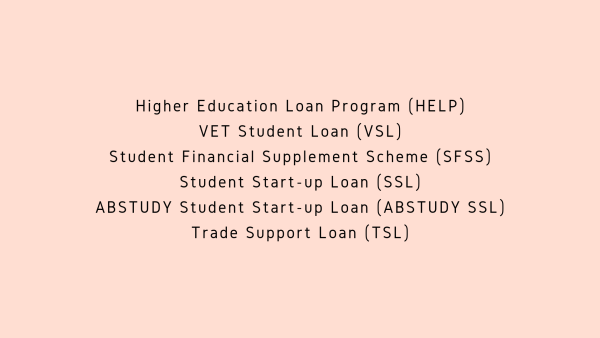
Just to note, when I talk about ‘HELP debts’ I’m also meaning a number of other study loans. These include:

So anytime I mention ‘HELP debt’ in this blog, I’m referring to these as well as the threshold is the same.

How do HELP debt repayments work?

In a nutshell once you reach a certain income threshold you have to start repaying your HELP debt based on percentage of your income. Essentially if you’re fresh out of uni and still haven’t found a well-paying job, you’re not going to be forced to pay back that debt until you reach the repayment income threshold.

Similar to how tax is calculated, the more money you earn the higher your HELP debt repayments will be. So if you are earning a great salary straight out of uni and do this for a number of years, you are going to pay back your HELP debt a lot quicker than, for example, someone who starts on a lower salary and their salary slowly increases throughout their career.

HELP debt repayment threshold

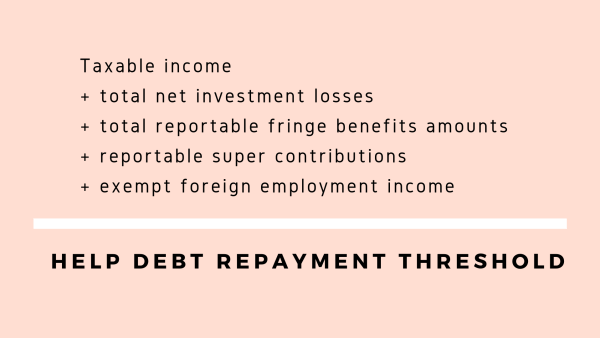
Your HELP debt repayment income is different to your taxable income. It’s calculated by:

Updated HELP debt threshold

So why is this so relevant right now? Because the threshold changed from 1 July 2019. In the 2019 financial year the repayment income threshold was $51,957. So if your income was under this threshold you didn’t have to repay your HELP debt during the 2019 financial year. Moving into the 2020 financial year the new threshold has dropped down to $45,881.

So what does this mean? It means that a lot more people are going to be captured under the new threshold and will have to start repaying back their HELP debts! A whole bunch of uni grads are going to have to start paying back their uni debts a lot sooner than expected.

Here’s the table for the 2020 financial year:

TFN declaration

When you are start a new job, it is so important to complete your tax file number declaration correctly. It’s even more important when you have a HELP debt that you tick the correct box. What happens is your employer will enter you into their payroll system as you having a HELP debt, therefore should be withholding enough tax for your normal individual income tax and HELP debt repayment.

What happens if you don’t tick this box? More likely than not you are probably going to have a tax bill at the end of the financial year because not enough tax is being withheld. So if you are an employee and unsure what you did on your TFN declaration, just check with your employer to see if they have set you up with the correct tax withholding. If they haven’t being withholding correctly, get them to update it ASAP and maybe look at saving some extra pennies for a potential tax debt – so best get some tax agent advice on this!

What happens if I am self employed?

Regardless if you are an employee or work for yourself, the rules still apply to you. It just means that you are going to have to put aside some extra money on top of the tax calculated on your taxable income. If you want to learn more about how your tax is calculated, I’ve got a separate blog on my website all about it, so you can check it out.

What about voluntary repayments

Yes, you can make voluntary repayments to your HELP debt even if you are under the current repayment threshold.

How do I check my HELP debt balance?

The easiest way to check your HELP debt balance it to log onto you’re MyGov account. Once you’ve linked the ATO you’ll be able to see the HELP debt balance. Alternatively, you can call the ATO directly or speak with you trusted tax agent for a balance update.

Debt increases

What a lot of people don’t realise is that your HELP debt increases in line with the consumer price index. So your $30k HELP debt from 5 years again, assuming your haven’t made any repayments, is going to be a little more with the CPI increases each year if you check your balance today. Currently the indexation rate was somewhere around 2%. Yes, your HELP debt is an interest free loan, but the indexation is applied to your debt to maintain its ‘real value’ by adjusting it in line with changes in the cost of living. I think of it as the value of a dollar today isn’t the same as the value of a dollar 10 years ago.

I hope this blog was helpful. Remember, tax legislation is changing all the time, so please double check the HELP debt income threshold rates before making any calculations. If you have specific questions about your own HELP debt, contact your trusted accountant to get the right advice.

What is the Medicare Levy?

I recently received my Wondersmile aligners and it got me thinking about private health insurance and health care in Australia, more commonly known as Medicare. So I thought I’d give you a quick rundown.

What’s the Medicare Levy? And how does it get calculated? What happens if I have private health insurance? What happens if I don’t?

Medicare in Australia

Medicare gives us access to health care here in Australia. Medicare gives us access to:

  • free or subsidised treatment by health professionals such as doctors, specialists, optometrists, dentists and other allied health practitioners (in special circumstances only).
  • free treatment and accommodation as a public (Medicare) patient in a public hospital.
  • 75% of the Medicare Schedule fee for services and procedures if you are a private patient in a public or private hospital (not including hospital accommodation and items such as theatre fees and medicines).

Medicare levy

The Medicare levy is an additional tax, which is not included in the individual income tax rates. The current Medicare rate is 2% of your taxable income.

Medicare levy surcharge

If your income reaches a certain threshold and you don’t have appropriate level of private health insurance, you may have to pay the Medicare levy surcharge. The additional surcharge ranges from 1% to 1.5% of your taxable income.

As a single with no private health insurance and your taxable income is less than $90k per year, you won’t have to pay the Medicare levy surcharge. If you are between $90k to $105k you will get charged a surcharge 1% of your taxable income, increasing to 1.25% if you are between $105k to $140k and increasing again to 1.5% over $140k.

For family and family’s with dependents the threshold goes up for each dependent child.

Note: The family income threshold is increased by $1,500 for each Medicare levy surcharge dependent child after the first child.

Medicare levy example 

Let’s run through an example on how to calculate the Medicare levy on your taxable income. We have James. He’s self employed builder, who doesn’t have private health insurance, is single with no dependents.

If James had adequate private health insurance, he wouldn’t have to pay the 1.5% Medicare levy surcharge of $2,250.

In relation to your specific tax scenario, you are going to have to do your own research and work out the cost of private health insurance per year and the cost of the Medicare levy surcharge.

Private Health Insurance

What benefits does private health insurance give me?

Aside from the fact that you won’t have to fork out money for extra tax to pay, it’s going to give you a multitude of benefits. I’m not a health insurance expert, so I’ll leave the nitty gritty details up to them. Definitely shop around and go with a provider that suits your health needs.

Can I claim Wondersmile?

This will depend on the type of private health cover you have. Again, I’m no expert, so definitely do you research around getting the right private health insurance for the health procedures you need!

I hope this blog was helpful. Remember, tax legislation is changing all the time, so please double check the current Medicare levy rates before making any calculations.

If you have specific questions about your own tax when it comes to the Medicare levy, contact your trusted accountant to get the right advice. Also speak with a trusted health care provider if you have any question in relation to insurance cover and benefits.